Scope of Research
Transition-metal oxides show lots of interesting and useful properties. They include ferroelectrics, ferromagnets, conductors, batteries, and so on.
Some of the materials are widely used in current electronic devices. The wide variety of their crystal structures gives rise to various electronic structures, which lead to interesting and useful chemical and physical properties.
We are focusing on the fundamental chemistry and physics of such "functional oxides" and seeking new materials with new functions.
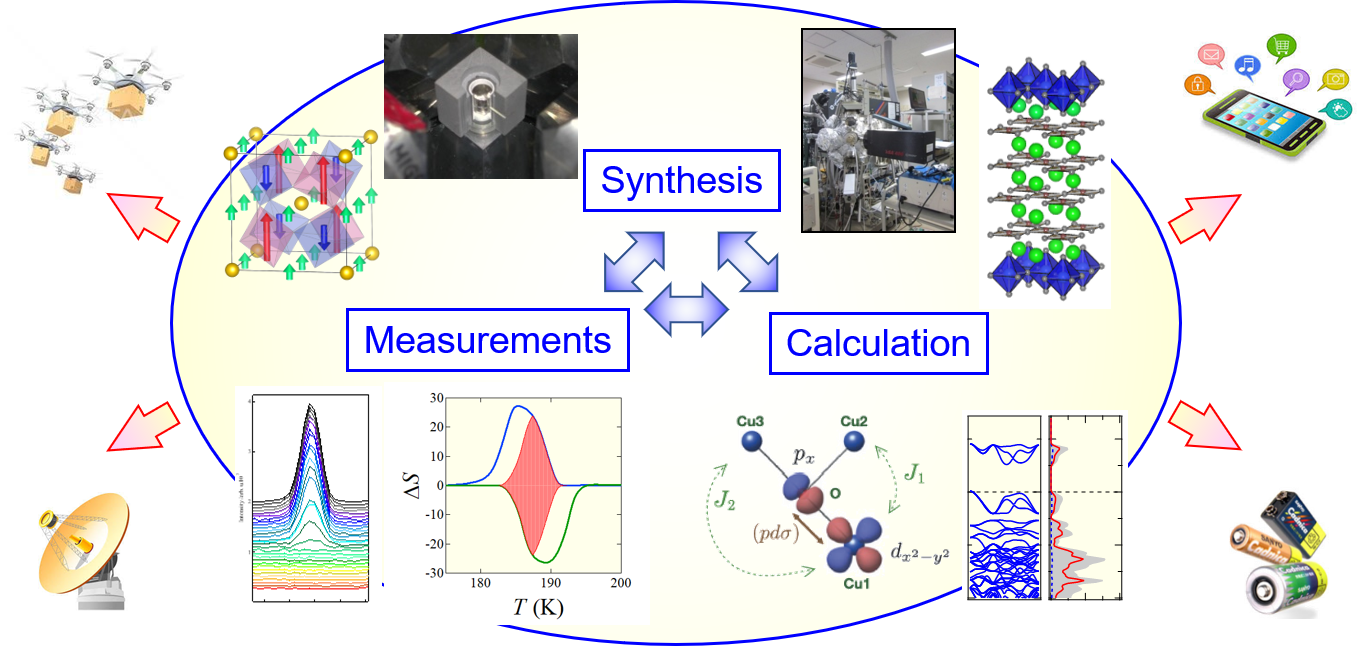
We are conducting systematic studies of material synthesis based on phase equilibrium information.
Precise crystal structures are analyzed by x-ray and neutron diffraction.
Electronic and magnetic structures are discussed based on the results of electronic structure calculations and physical property measurements.
Novel functional oxides
In transition metal oxides, the cation-d-orbital and anion-p-orbital are strongly hybridized. Competitive and/or cooperative energies of Coulomb interaction,
band-width, and exchange interaction also play an important role in giving rise to a wide variety of chemical and physical properties.
Such exotic properties could be useful for the functions of electronic and spintronic devices.
Recent significant developments in x-ray and neutron diffraction techniques enable us to determine the detailed crystal structures of such oxides.
The information about the structures also provides a basis for electronic structure calculations.
We can thus discuss the relationships between the fundamental properties and structure features.